Compare Listings

The Cost of Poor Renter Selection
The Cost of Poor Renter Selection

The Cost of Poor Renter Selection

Why Choosing the Right Renter Matters

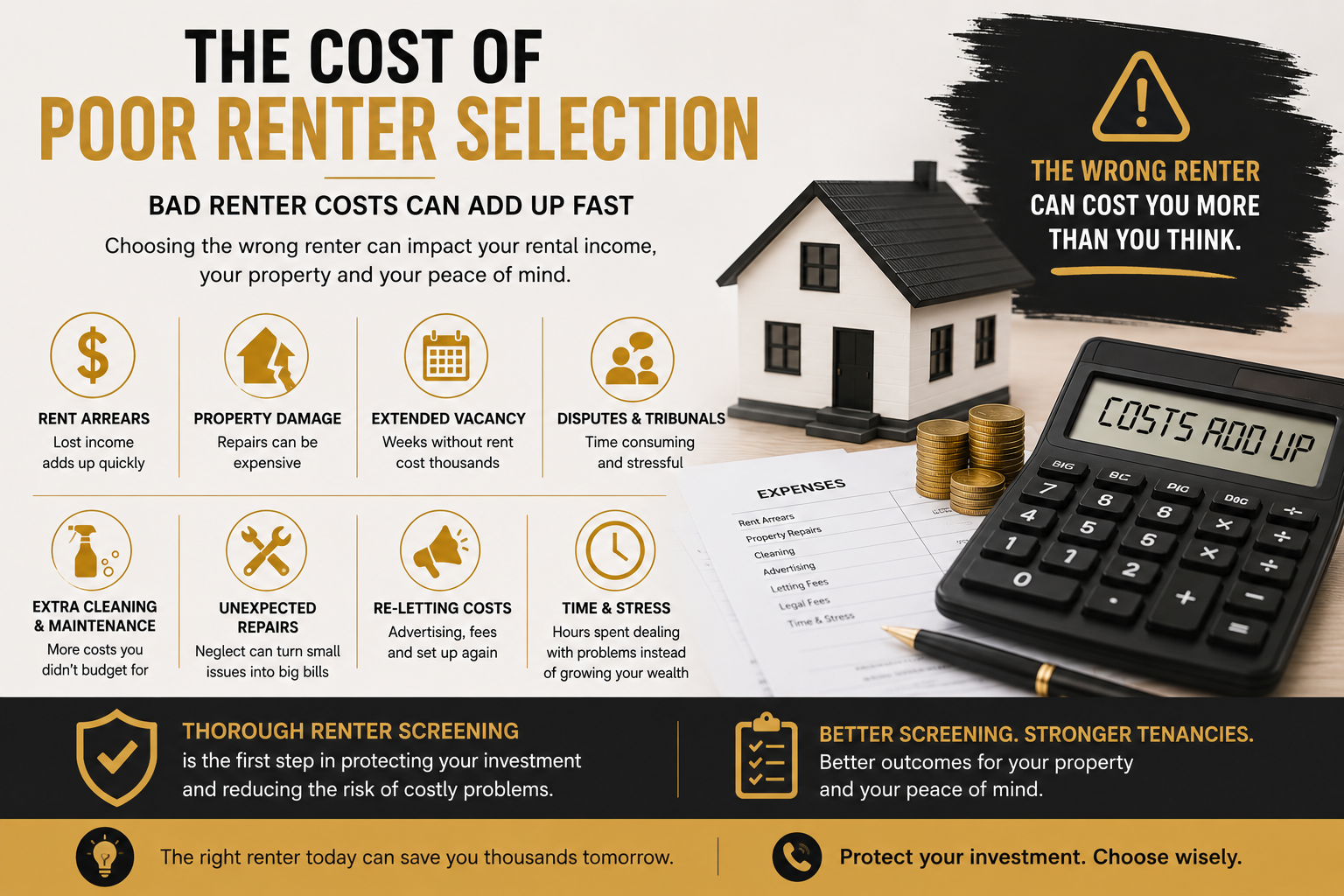
Bad renter costs can extend far beyond a missed rent payment. Poor renter selection can lead to arrears, property damage, additional maintenance, disputes, extended vacancy and considerable time spent resolving problems.

For rental providers, selecting a suitable renter is therefore one of the most important decisions made during the management of an investment property.

At Verdi Property Management, we believe the goal isn’t simply to lease a property as quickly as possible. It’s to carefully assess applications, verify relevant information and help rental providers make informed decisions about who will occupy their investment.

A thorough renter screening process cannot eliminate every risk, but it can significantly improve the information available when selecting a renter.


What Can a Poor Renter Really Cost You?

The financial impact of an unsuccessful rental agreement isn’t always immediately obvious.

Potential costs can include:

  • Unpaid rent and arrears
  • Property damage beyond fair wear and tear
  • Additional cleaning
  • Repairs and maintenance
  • Administrative and dispute-related costs
  • Lost rent during vacancy
  • Re-advertising and reletting costs
  • Time spent resolving issues

When several of these occur during the same rental agreement, the total cost can quickly become significant.

This is why focusing solely on securing the highest possible weekly rent or filling a vacancy as quickly as possible can sometimes be short-sighted.


1. Rent Arrears Can Quickly Add Up

One of the most obvious bad renter costs is unpaid rent.

Consider a property renting for $600 per week.

Two weeks of unpaid rent represents $1,200 in lost rental income. Four weeks represents $2,400.

If the situation takes time to resolve, the financial impact can continue to increase.

Effective property management requires consistent rent monitoring so missed payments can be identified and addressed promptly in accordance with Victorian rental requirements.


2. Property Damage Can Be Expensive

Normal wear and tear is part of owning a rental property.

Damage beyond fair wear and tear is different.

Depending on the circumstances, costs could potentially involve:

  • Damaged walls
  • Broken doors
  • Damaged flooring
  • Broken fixtures
  • Garden damage
  • Missing items
  • Excessive cleaning
  • Damage to appliances or fittings

Even where compensation may be available through a bond claim or other process, the rental provider can still face considerable disruption and administration.

Good renter screening cannot guarantee that damage won’t occur, but previous rental history and references can provide useful information when assessing an application.


3. Vacancy Creates an Immediate Financial Cost

A problematic rental agreement can sometimes result in additional vacancy.

If a $600-per-week property remains vacant for three weeks, that’s:

$600 × 3 = $1,800 in potential lost rental income.

There may also be additional costs associated with cleaning, repairs, advertising and preparing the property for another renter.

This demonstrates why the real objective shouldn’t simply be achieving the highest weekly rent.

The goal should be maximising the property’s long-term rental performance.


4. Releasing the Property Creates Additional Costs

When a rental agreement ends unexpectedly or unsuccessfully, the property may need to go through the leasing process again.

This can involve:

  • Advertising
  • Photography where required
  • Open inspections
  • Application processing
  • Cleaning
  • Maintenance
  • Rental agreement preparation
  • Additional vacancy

There can also be leasing or letting fees where professional property management services are used.

Selecting a suitable renter from the beginning can therefore have considerable long-term value.


5. Disputes Take Time to Resolve

Not every disagreement becomes a formal dispute, but when matters escalate they can require significant time and documentation.

A dispute may require reviewing:

  • Entry condition reports
  • Routine inspection reports
  • Exit condition reports
  • Photographs
  • Invoices
  • Rental ledgers
  • Emails and correspondence
  • Contractor reports
  • Quotes

Depending on the circumstances, a matter may also proceed through Victoria’s applicable dispute resolution or tribunal processes.

Accurate records throughout the rental agreement become extremely important when disagreements arise.


6. Poor Property Care Can Create Longer-Term Problems

Some issues aren’t immediately visible.

Poor property care can contribute to problems such as:

  • Unreported water leaks
  • Excessive moisture
  • Unreported maintenance
  • Garden deterioration
  • Damage worsening over time

A relatively inexpensive repair can become considerably more expensive when it isn’t reported promptly.

This is one reason renter selection should be supported by regular routine inspections and proactive property management after the renter moves in.


7. The Bond May Not Cover Everything

Rental providers sometimes assume the bond provides complete protection against unpaid rent or damage.

That isn’t necessarily the case.

Depending on the amount of loss and the circumstances, the cost of unpaid rent, cleaning or damage may exceed the bond available.

The existence of a bond shouldn’t therefore replace thorough renter selection, good documentation and appropriate insurance.


8. Insurance Is Important—But It Doesn’t Replace Good Management

Appropriate insurance can provide valuable protection for an investment property, subject to the policy’s terms, exclusions, excesses and coverage limits.

However, insurance shouldn’t be treated as a substitute for good property management.

A stronger risk-management approach combines:

Renter screening + proactive management + good documentation + appropriate insurance.

Rental providers should obtain independent advice regarding the insurance cover suitable for their circumstances.


The Hidden Cost: Your Time

Not every cost appears on an invoice.

Managing a difficult rental agreement can involve hours of:

  • Phone calls
  • Emails
  • Contractor coordination
  • Following up rent
  • Reviewing documentation
  • Conducting inspections
  • Obtaining quotes
  • Managing disagreements
  • Preparing evidence

For self-managing rental providers, this can become particularly demanding.

Professional property management provides separation between the rental provider and renter while ensuring issues are managed through established processes.


Why the Highest-Income Applicant Isn’t Automatically the Best Renter

Income and affordability are important considerations, but they shouldn’t necessarily be viewed in isolation.

A thorough application assessment considers relevant information across the entire application.

This may include:

  • Identity
  • Income and affordability
  • Employment information
  • Previous rental history
  • Rental references
  • Supporting documentation
  • Consistency of information provided

The objective is to build a complete picture rather than make a decision based on a single factor.


Why Rental History Matters

Previous rental history can provide useful information about an applicant’s experience as a renter.

Where appropriate and available, property managers may seek to verify matters such as:

  • Rental payment history
  • Length of previous rental agreements
  • Property care
  • Rental references
  • Information provided in the application

A strong rental history doesn’t guarantee a future outcome, just as limited rental history doesn’t automatically make someone unsuitable.

It is simply one component of a broader assessment.


How Verdi Property Management Screens Renters

At Verdi Property Management, we use a structured renter screening process designed to provide rental providers with relevant information before approving an application.

Our process can include:

Identity Verification

Reviewing appropriate identification and ensuring application information is consistent.

Income and Affordability

Reviewing relevant income information and supporting documentation.

Employment Checks

Verifying relevant employment information where appropriate.

Rental History

Reviewing previous rental arrangements and relevant rental history.

Reference Checks

Contacting appropriate rental references to verify information supplied.

Document Verification

Reviewing supporting documentation and identifying information that may require clarification.

Overall Application Assessment

Considering the application as a whole rather than relying on one individual factor.

Most importantly, applications are assessed using a fair and consistent process in accordance with applicable Victorian requirements.


Renter Screening Is Only the Beginning

Even excellent renter screening cannot predict everything that will happen during a rental agreement.

That’s why renter selection needs to be followed by proactive management.

Once a renter moves into a property, good management includes:

  • Monitoring rental payments
  • Conducting routine inspections
  • Managing maintenance promptly
  • Maintaining accurate records
  • Reviewing rent when appropriate
  • Communicating professionally
  • Addressing issues early

The combination of careful renter selection and proactive ongoing management provides much stronger protection than either approach alone.


A $10 Rent Difference Can Be Less Important Than Renter Quality

Imagine two applications for a property.

One applicant offers $610 per week, while another suitable applicant would rent the property for $600 per week.

The difference is:

$10 × 52 weeks = $520 per year.

Now compare that $520 with the potential cost of:

  • Several weeks of arrears
  • Additional vacancy
  • Property damage
  • Cleaning
  • Repairs
  • A dispute

This doesn’t mean rental providers should automatically accept a lower offer or that one applicant is inherently better than another.

It demonstrates why weekly rent shouldn’t be the only consideration when assessing the overall performance and risk of an investment property.


Frequently Asked Questions

Can Renter Screening Prevent Rent Arrears?

No screening process can guarantee that rent arrears won’t occur. People’s circumstances can change. Thorough screening can, however, provide better information about an application before a rental agreement begins.

What Should Be Checked When Selecting a Renter?

Relevant checks can include identification, affordability, employment information, previous rental history, references and supporting documentation.

Does a Good Rental History Guarantee a Good Renter?

No. Previous rental history is useful information, but it cannot guarantee future behaviour or circumstances.

Is It Better to Wait for a Better Applicant?

This depends on the circumstances. Extended vacancy also has a financial cost, so renter selection requires balancing application quality, market conditions and vacancy risk.

Can a Property Manager Reduce the Risk of a Poor Rental Outcome?

Professional property management cannot eliminate risk. However, structured renter screening, rent monitoring, routine inspections, maintenance management and accurate documentation can help reduce and manage many common risks.


Protect Your Investment From the Beginning

The cost of poor renter selection can extend well beyond unpaid rent.

Vacancy, damage, maintenance, disputes and the time involved in resolving problems can all affect the performance of an investment property.

That’s why at Verdi Property Management, we don’t view renter selection as simply filling a vacancy.

Our approach combines thorough renter screening with proactive ongoing property management to help rental providers protect their properties and make informed decisions throughout the rental agreement.

If you’re looking for a property manager in Geelong who takes renter selection and risk management seriously, contact Verdi Property Management to discuss your investment property or arrange a complimentary rental appraisal.


Related Resources

Continue learning with our helpful guides for Geelong rental providers:


Contact Verdi Property Management today to learn how we can help you manage your investment property with confidence and remain compliant with Victoria’s rental laws.


Disclaimer

The information in this article is provided for general educational purposes only and should not be considered financial, legal or taxation advice. Rental market conditions can change over time, and every investment property is different. You should seek independent professional advice that considers your individual circumstances before making decisions relating to your investment property.

This article is particularly valuable because it targets rental providers actively searching for solutions to a common problem. It naturally demonstrates your expertise while leading readers toward a complimentary rental appraisal or property management enquiry, making it an excellent lead-generation piece for your website.

Related posts

How We Screen Renters at Verdi Property Management

How We Screen Renters at Verdi Property Management Finding the Right Renter for...

Continue reading

Should You Self-Manage Your Investment Property?

Should You Self-Manage Your Investment Property? Self-Managing vs Using a...

Continue reading

End of Financial Year Tips for Property Investors

End of Financial Year Tips for Property Investors Prepare Your Investment Property...

Continue reading