Why Good Property Management Saves Money
- 12 October 2026
- Rental Providers, Property Management
- 0

Why Good Property Management Saves Money
The Value of Professional Property Management Goes Beyond the Management Fee
One of the most important property management benefits is often overlooked: good property management can save rental providers money.
When comparing property managers, it’s easy to focus primarily on the management fee. After all, the fee is visible and easy to compare between agencies.
But the cheapest property manager isn’t necessarily the most cost-effective.
The financial performance of an investment property can be affected by vacancy, renter selection, rent arrears, maintenance, rent reviews, compliance, property condition and how quickly problems are identified and resolved.
Good property management focuses on managing all of these areas proactively.
At Verdi Property Management, our objective isn’t simply to collect rent. It’s to help rental providers protect their property, reduce unnecessary costs and achieve stronger long-term rental outcomes.
1. Reducing Vacancy Can Save Thousands
Vacancy is one of the largest potential costs for a rental provider.
Consider a property renting for $600 per week.
Every week the property remains vacant represents approximately $600 in potential lost rental income.
A four-week vacancy could represent:
$600 × 4 = $2,400
This means the difference between an effective leasing campaign and a poorly managed one can quickly outweigh relatively small differences in management fees.
Good vacancy management involves:
- Setting a realistic asking rent
- Preparing the property appropriately
- Creating an effective advertisement
- Responding promptly to enquiries
- Conducting inspections
- Processing applications efficiently
- Monitoring enquiry and adjusting strategy where necessary
The objective is not simply to fill the property quickly. It’s to find the right balance between rental return, renter quality and vacancy.
2. Good Renter Selection Can Reduce Risk
Selecting a suitable renter is one of the most important decisions made during a rental agreement.
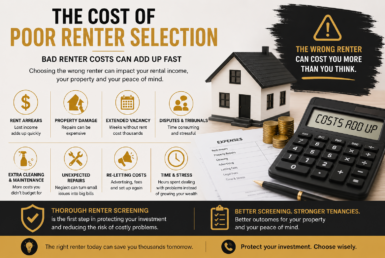
Poor renter selection can potentially contribute to:
- Rent arrears
- Property damage
- Additional cleaning
- Disputes
- Early vacancy
- Re-letting costs
- Additional administration
A thorough renter screening process can include reviewing relevant:
- Identification
- Income and affordability
- Employment information
- Rental history
- References
- Supporting documentation
No screening process can guarantee how a rental agreement will perform, but a structured and consistent assessment provides rental providers with better information when making their decision.
This is one of the property management benefits that can be difficult to measure until something goes wrong.
3. Accurate Rent Reviews Help Protect Rental Income
Another way good property management can save—or make—a rental provider money is through appropriate rent reviews.
If a property remains below market rent for an extended period, the lost income can become significant.
For example, if a property could reasonably achieve an additional $20 per week, the difference over a full year is:
$20 × 52 = $1,040
At $40 per week, the difference becomes:
$2,080 per year.
However, maximising rental performance doesn’t mean increasing rent as aggressively as possible.
A good property manager considers:
- Comparable properties
- Recently leased properties
- Current listings
- Renter demand
- Property condition
- Vacancy risk
- Applicable Victorian rent increase requirements
Sometimes retaining a reliable renter at an appropriate market rent may produce a better overall result than pursuing the highest possible weekly figure.
4. Preventative Maintenance Can Reduce Larger Repair Bills
Small maintenance issues can become expensive when they’re ignored.
A minor leak might eventually result in:
- Water damage
- Mould
- Damaged cabinetry
- Flooring damage
- Plaster repairs
- Painting
Good property management isn’t about avoiding maintenance expenditure.
It’s about identifying issues early and dealing with them before they become larger and more expensive.
Routine inspections, renter communication and reliable contractors all play an important role.
5. Routine Inspections Help Protect the Property
Routine inspections provide an opportunity to monitor the condition of an investment property throughout the rental agreement.
A thorough inspection may identify:
- Water leaks
- Mould or moisture
- Deterioration
- Maintenance requirements
- Garden issues
- Damage
- Safety concerns
- Preventative maintenance opportunities
Identifying an issue six months earlier can sometimes make a considerable difference to the eventual repair cost.
Routine inspections also create an ongoing record of the property’s condition, which can become important if issues arise later.
6. Managing Rent Arrears Early Matters
Even a suitable renter can experience financial difficulties.
The important factor is how quickly arrears are identified and managed.
A professional property management system should monitor rental payments and identify missed rent promptly.
This allows appropriate communication and action to occur in accordance with Victorian rental requirements.
Allowing arrears to accumulate without consistent follow-up can increase the financial exposure of the rental provider.
7. Good Maintenance Management Helps Control Costs
Simply sending every maintenance request to a contractor isn’t necessarily good property management.
Effective maintenance management involves understanding:
- What the renter has reported
- Whether the issue is urgent
- Whether additional information is required
- Which contractor is appropriate
- Whether a quote should be obtained
- Whether the rental provider’s approval is required
- Whether previous work has been completed on the same issue
Good communication between the renter, property manager, rental provider and contractor can help prevent unnecessary call-outs and duplicated work.
It can also ensure legitimate maintenance is addressed before it becomes more serious.
8. Compliance Mistakes Can Be Expensive
Victorian rental properties are subject to extensive legislative and compliance requirements.
Depending on the property, these can include requirements relating to:
- Minimum rental standards
- Gas safety checks
- Electrical safety checks
- Smoke alarms
- Heating
- Entry notices
- Rent increases
- Repairs
- Rental agreements
- Bonds
- Record keeping
Legislation can also change.
One of the significant property management benefits is having someone responsible for managing the rental agreement within an established compliance framework.
While professional management cannot remove every legal risk, it can help rental providers avoid preventable administrative and compliance mistakes.
9. Good Documentation Can Protect You During a Dispute
Documentation might not seem financially important—until there’s a disagreement.
Strong property management records can include:
- Entry condition reports
- Photographs
- Routine inspection reports
- Rental ledgers
- Maintenance records
- Contractor invoices
- Emails and correspondence
- Notices
- Exit condition reports
If a dispute arises regarding rent, maintenance, property condition or a bond, accurate documentation can become extremely valuable.
Trying to reconstruct evidence after the event is much more difficult.
10. Professional Property Management Saves Time
Time has value too.
Self-managing a property can involve:
- Advertising
- Answering enquiries
- Conducting inspections
- Processing applications
- Checking references
- Monitoring rent
- Responding to maintenance
- Organising contractors
- Conducting routine inspections
- Managing rent reviews
- Keeping records
- Managing vacates
- Handling disputes
A well-performing rental agreement may require relatively little attention for periods of time.
But when several issues arise simultaneously, the workload can increase quickly.
For many investors, one of the most valuable property management benefits is simply having someone else responsible for the day-to-day management of the property.
Cheap Property Management vs Good Property Management
Consider two agencies managing a property at $600 per week.
One charges slightly less but:
- Takes longer to respond to enquiries
- Doesn’t conduct regular rent reviews
- Provides limited inspection reporting
- Is reactive with maintenance
- Has inconsistent renter screening
The other charges slightly more but actively manages each of these areas.
A small difference in management fees can quickly become insignificant compared with:
- One additional week of vacancy
- An unnecessary maintenance call-out
- Missed rent increases
- Preventable property deterioration
- Poor renter selection
The question shouldn’t only be:
“What percentage do you charge?”
It should also be:
“What am I receiving for that fee?”
The Cost of One Extra Week of Vacancy
This is one of the easiest ways to put property management fees into perspective.
If your property rents for $600 per week, one unnecessary additional week of vacancy costs approximately $600 in lost rent.
At $700 per week, it’s approximately $700.
Good leasing management that reduces vacancy by even a relatively small amount can therefore have a meaningful effect on annual performance.
Good Property Management Is About the Whole Investment
The role of a property manager isn’t simply collecting rent and arranging repairs.
Good property management considers the entire rental lifecycle:
Preparing the property → Pricing → Marketing → Renter selection → Rental agreement → Rent collection → Inspections → Maintenance → Compliance → Rent reviews → Vacate → Re-leasing
Each stage creates opportunities to either protect or reduce the performance of the investment.
Managing these stages consistently is where professional property management can create value.
What Should You Expect From a Good Property Manager?
Rental providers should expect more than basic administration.
A good property manager should provide:
- Clear communication
- Thorough renter screening
- Proactive vacancy management
- Detailed routine inspections
- Prompt rent monitoring
- Appropriate rent reviews
- Maintenance coordination
- Compliance management
- Accurate record keeping
- Professional renter communication
- Practical advice when decisions need to be made
Most importantly, you should feel that someone is actively looking after your property rather than simply reacting when something goes wrong.
Frequently Asked Questions
Is Professional Property Management Worth the Cost?
It depends on your circumstances, but professional property management can provide value through vacancy management, renter screening, rent monitoring, inspections, maintenance coordination, compliance support and reduced administration.
Can a Property Manager Save Me Money?
Potentially. Effective management can help reduce unnecessary vacancy, identify maintenance early, monitor arrears, keep rent appropriately positioned and reduce avoidable administrative mistakes. No property manager can guarantee financial outcomes.
Should I Choose the Property Manager With the Lowest Fee?
Management fees are important, but they should be considered alongside the service being provided. A small fee difference can be outweighed by vacancy, poor communication, missed rent reviews or ineffective maintenance management.
What Are the Main Property Management Benefits?
Some of the main benefits include renter screening, rent collection, arrears monitoring, routine inspections, maintenance coordination, rent reviews, vacancy management, record keeping and compliance support.
Can I Change Property Managers During a Rental Agreement?
Generally, yes. Rental providers can change property managers while a renter remains in the property, subject to the terms of their existing management authority. The incoming agency can assist with coordinating the transfer.
Good Management Should Protect More Than Your Time
Choosing a property manager based solely on the lowest management fee can overlook the much larger financial picture.
One additional week of vacancy, an overlooked rent review or a maintenance issue allowed to deteriorate can potentially cost considerably more than a small difference in annual management fees.
At Verdi Property Management, we focus on proactive management throughout the entire rental agreement—from renter selection and rent monitoring to routine inspections, maintenance, compliance and rent reviews.
Our goal is simple: protect your property, reduce unnecessary costs and make investment property ownership easier.
If you’re considering changing property managers or would like to understand how your property is currently performing, contact Verdi Property Management for a confidential discussion or complimentary rental appraisal.
Disclaimer
This article provides general information only and does not constitute financial, investment, taxation or legal advice. Examples are illustrative only and actual rental income, expenses, vacancy and investment outcomes will vary. Rental providers should obtain independent professional advice appropriate to their circumstances.